This post was originally published on April 5, 2026
The latest update to this post was made 56 minutes ago ago.
VHF (2m) vs UHF (70cm) in Ham Radio
VHF and UHF are the two most popular frequency bands used by amateur radio operators (HAMs) for local and regional communication. Below we will discuss the basics of each.
Why Most New Hams Start Here
Most new amateur radio operators begin with VHF and UHF for good reason. After passing the Technician license exam, these are the bands they’re immediately allowed to use. Handheld radios (HTs) and mobile rigs for 2m and 70cm are affordable, easy to set up, and widely available. Local repeaters on these bands let beginners make contacts right away, join nets, and actually get on the air without needing tall antennas or high power. In short, VHF and UHF offer the quickest and most practical way to start using ham radio.
VHF – The 2-Meter Band
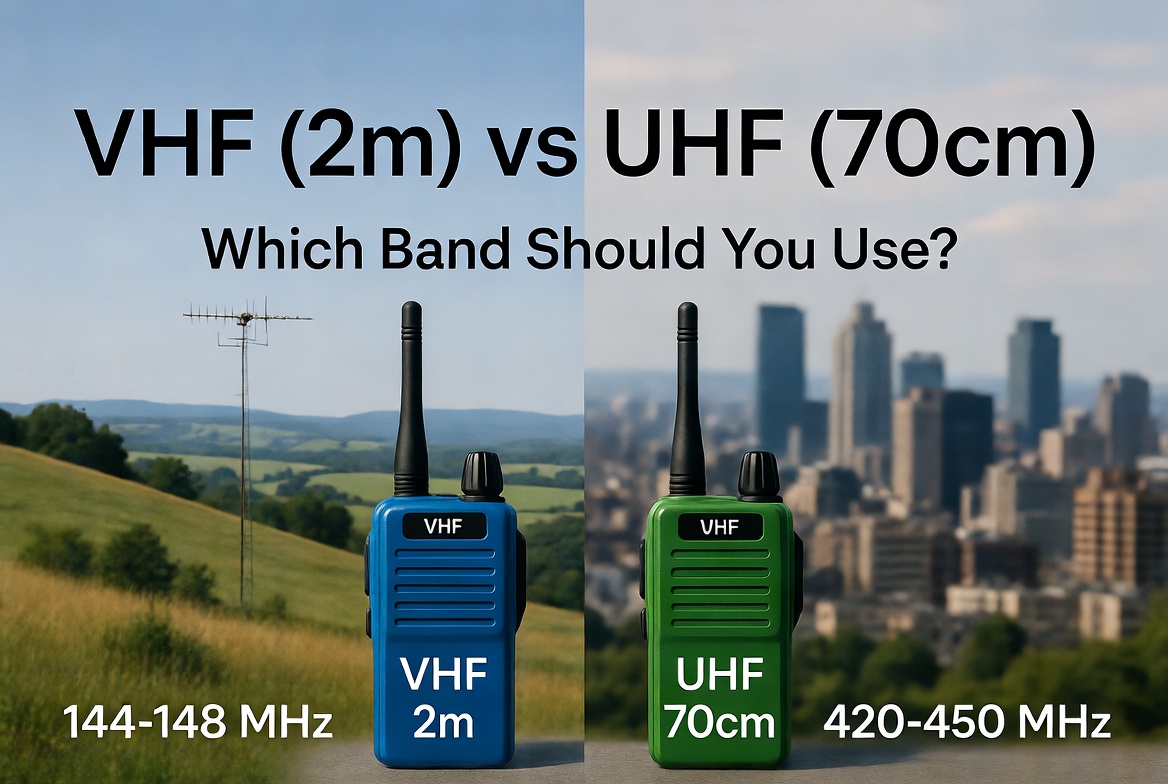
VHF (Very High Frequency) covers 30–300 MHz, with the popular 2-meter amateur band running from 144.000–148.000 MHz. It excels at line-of-sight communication and can reach up to 50 miles or more depending on terrain, antenna quality, and height. VHF is a favorite for rural areas, search-and-rescue operations, and emergency services because signals travel well over open ground.
UHF – The 70-Centimeter Band
UHF (Ultra High Frequency) spans 300 MHz to 3 GHz, with the main ham allocation at 420–450 MHz. UHF signals penetrate buildings, walls, and urban environments much better than VHF, making it a better choice for cities and indoor use. While UHF can have a shorter range in open terrain, real-world performance depends heavily on your antenna, power level, and elevation.
Repeaters – Extending Your Range
In practice, most local VHF and UHF conversations happen through repeaters. A repeater is an automated station (usually mounted high on a tower, hilltop, or tall building) that receives your signal on one frequency (the input) and instantly retransmits it on another frequency (the output) at higher power. This dramatically extends your range — turning a typical 5–10 mile handheld contact into 30–50+ miles or more, even if terrain or buildings are in the way.
On the 2-meter band, the standard offset is usually ±600 kHz. On the 70cm band, it’s typically ±5 MHz. Modern dual-band radios make this easy: you just select the repeater frequency from a list (or program it in), and the radio handles the offset automatically.
Final Thoughts
Neither band is universally better. Experienced hams choose based on the situation — VHF for maximum distance in open areas, and UHF for urban and indoor reliability. Many operators simply use dual-band radios that cover both, giving them the best of both worlds. By leveraging repeaters, even handheld radios and lower-powered units can achieve impressive distances! What’s your experience with 2m or 70cm? Do you prefer one band over the other? Leave a comment below!
Tags: #HamRadio #AmateurRadio #VHF #UHF #2m #70cm #2Meter #70Centimeter #HamRadioBeginner

Be the first to comment