This post was originally published on April 6, 2026
The latest update to this post was made 55 minutes ago ago.
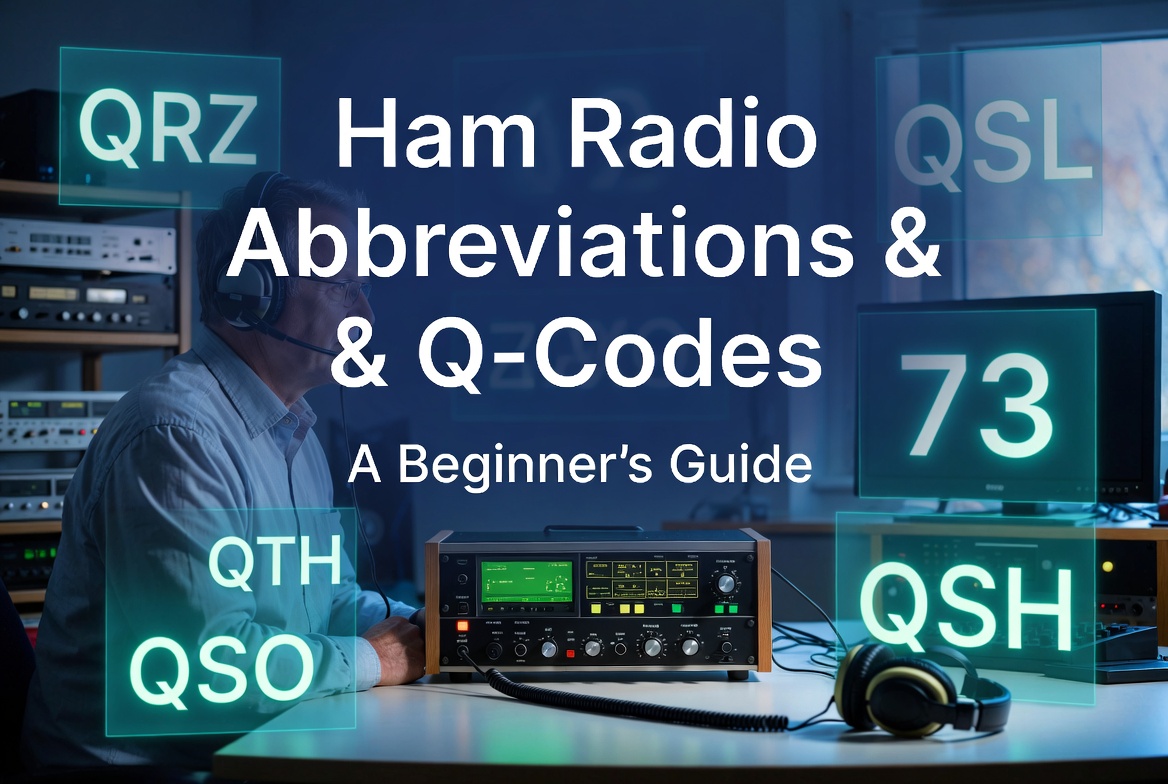
Ham Radio Abbreviations & Q-Codes
A Beginner’s Guide
If you’ve ever listened to a ham radio conversation, you’ve probably heard operators rapidly firing off strange combinations of letters like “QRZ?”, “QSL”, “73”, or “QRW?”. Don’t worry — it’s not a secret language. It’s simply a very efficient way for hams to communicate clearly and quickly, especially when conditions are poor or during contests. These abbreviations save time and reduce errors on the air. Here’s a practical guide to the most common ham radio abbreviations and Q-codes every new ham should know!
What Are Q-Codes?
Q-codes were originally developed for maritime and military radio use in the early 1900s. Today, amateur radio operators worldwide use them as a universal shorthand.
Here are the most useful Q-codes for beginners
| Q-Code | Meaning | Common Usage Example |
|---|---|---|
| QRZ | Who is calling me? | “QRZ? This is W5ABC” |
| QSL | I confirm receipt / I acknowledge | “QSL on that frequency” |
| QSO | A contact or conversation between two stations | “Nice QSO with you!” |
| QRV | I am ready / I am prepared to operate | “QRV for the net” |
| QRW | Shall I inform [station] you are calling? | “QRW W5XYZ that you’re calling?” |
| QTH | My location | “My QTH is Fort Worth, Texas” |
| QRM | Man-made interference / noise | “I’m getting a lot of QRM” |
| QRN | Natural atmospheric noise / static | “Heavy QRN tonight” |
| QSY | Change frequency | “Let’s QSY to 146.520” |
| QRT | Closing down / stopping transmission | “I’m going QRT for the night” |
| QRS | Send more slowly | “QRS please, I’m still learning” |
| QSB | Your signal is fading | “You’re QSBing badly” |
| 73 | Best regards / Goodbye (friendly sign-off) | “73 and hope to catch you again!” |
| 88 | Love and kisses (used between YLs or XYLs) | “88 de W5ABC” |
Other Common Ham Radio Abbreviations
| Abbreviation | Meaning |
|---|---|
| CQ | General call (“Calling any station”) |
| DX | Long-distance contact |
| OM | Old Man (any male operator) |
| YL | Young Lady (female operator) |
| XYL | Wife (ex-young lady) |
| 599 | Signal report (excellent signal strength) |
| RST | Readability, Strength, Tone report |
| de | “From” (e.g., W5ABC de K5XYZ) |
| PSE | Please |
| TX | Transmit |
| RX | Receive |
| Ant | Antenna |
| Rig | Radio / transceiver |
| HT | Handheld transceiver |
| FM | Frequency Modulation |
| SSB | Single Side Band |
| CW | Continuous Wave (Morse code) |
| Net | Scheduled group communication on a repeater |
Quick Tips for New Hams
- Don’t be afraid to ask for a “QRS” (send slower) if someone is going too fast.
- When in doubt, speak normally instead of forcing abbreviations.
- “73” is the universal friendly sign-off — you can never go wrong with it.
- Listening is the best way to learn. Spend time monitoring local repeaters and HF frequencies before jumping in.
Final Thoughts
Learning ham radio abbreviations and Q-codes might feel overwhelming at first, but you’ll pick them up quickly once you start listening and making contacts. They’re tools that make communication faster and clearer — especially when band conditions are rough. Start with the basics (QRZ, QSL, QSO, 73) and build from there. Before long, you’ll be using them naturally.
Tags: #HamRadio #AmateurRadio #QCodes #HamRadioQCodes #73 #QRZ #HamRadioBeginner

Be the first to comment